- Home
- News Releases
- Back Issues
- February FY2026
- 32nd Asian Export Control Seminar Held
32nd Asian Export Control Seminar Held
February 10, 2026
Joint News Release with the Ministry of Foreign Affairs
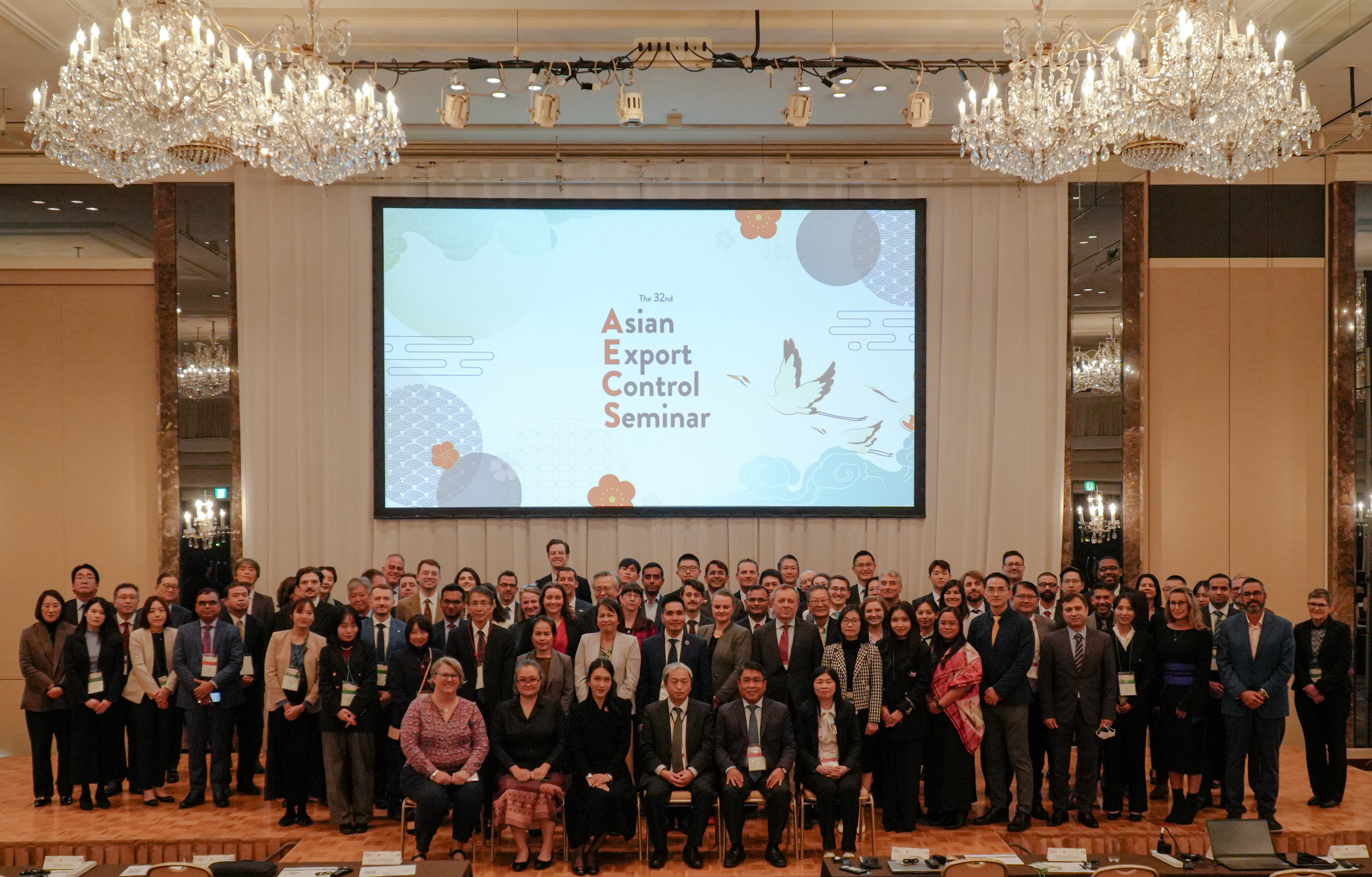
For three days from Tuesday, February 3, to Thursday, February 5, 2026, the Asian Export Control Seminar was held in Tokyo by the Center for Information on Security Trade Control (CISTEC) as an organizer, jointly with the Ministry of Economy, Trade and Industry (METI) and the Ministry of Foreign Affairs (MOFA) as co-organizers. This 32nd round of the seminar brought together about 130 people from more than 30 countries, regions and international organizations.
1. Background to and overview of the seminar
The Asian Export Control Seminar aims to encourage Asian countries and regions to introduce export control systems and enhance their implementation, thereby contributing to an international effort for the non-proliferation of weapons of mass destruction (WMDs). The seminar works to provide an opportunity for experts from government agencies and international organizations around the world, including Asia, to gather to exchange views and share information, including the latest challenges and best practices of export control implementation, thereby supporting the awareness raising of the importance of export control.
2. Outline of the seminar
(1) Highlights of the seminar (with names of countries and regions listed in the order of presentation)
Latest trends in the development of export control systems
Presenters of Japan, the European Union (EU), Singapore and the Philippines explained their latest security issues and efforts to address them. Specifically, views were exchanged on the initiatives implemented by each country and region to address various issues concerning export control. These issues include the impact of economic security on export control; the rising risk of dual-use items being repurposed for military applications; approaches to export control for advanced semiconductors, AI, quantum and other emerging technologies; and the importance of cooperation for export control in Asia, especially in the ASEAN region.
Export control systems in Asian countries and regions
Presenters of Thailand, Bangladesh, Lao PDR, Cambodia, Malaysia and Pakistan explained their latest export control measures and challenges.
Specifically, they presented their efforts to develop legal systems based on international frameworks, such as the UN Security Council Resolution 1540, and to increase the effectiveness of their export control systems through the introduction of catch-all regulations and risk-based export licensing examinations as well as through the spread use of internal compliance programs (ICPs). Furthermore, the presenters referred to their outreach activities to the industries and academia, human resource development efforts, the retention of personnel and enforcement systems of related domestic organizations and the need to enhance collaboration among these organizations, and other challenges faced by these countries.
Moreover, views were exchanged on the sophistication of export licensing examinations and enforcement systems through digitalization, such as the introduction of electronic application systems, and on measures to make trade facilitation compatible with security export control.
Export control in the context of AI and economic growth
Two thinktank experts made speeches on (1) export control issues concerning AI and related technologies, and the possibility of utilizing AI for export licensing examinations and risk assessment in export control procedures, and (2) the economic effect and positive impact on economy brought about by the introduction of export control systems.
Thematic session (intangible technology transfer)
Presenters of the Netherlands, Norway, the Republic of Korea, Canada and Japan explained their latest measures to ensure the appropriate transfer of intangible technologies, including the enhancement of their outreach activities to universities and academic institutions, response to cloud computing, and the proactive promotion of government-industry information sharing.
Thematic session (export licensing examination)
Presenters of the United Kingdom, Germany, Luxembourg and the Philippines outlined their export licensing examination systems, including the export licensing examination policies and processes and inter-agency cooperation for risk assessment, as well as their challenges concerning human resource development.
Thematic session (enforcement of and compliance with laws)
Presenters of Australia, Switzerland, India and Japan explained their efforts for the enforcement of legal systems and compliance with laws, including outreach activities to industries, the enhancement of exporters’ compliance and studies on noncompliance cases.
Presentations by international organizations and international export control regimes
Representatives of Japan, the UN Office for Disarmament Affairs and academia explained the latest efforts made by their organizations for the non-proliferation of weapons of mass destruction, such as outreach activities. In addition, the chairperson or head of the secretariat of each of the following multilateral export control regimes explained their latest initiatives in light of their respective roles and the evolution of technology: the Nuclear Suppliers Group (NSG), the Australia Group (AG), the Missile Technology Control Regime (MTCR) and the Wassenaar Arrangement (WA).
(2) Results of the seminar
The 32nd round of the seminar brought together about 130 stakeholders of export control from many countries and regions in and outside Asia as well as from international organizations and multilateral export control regimes. Participants exchanged information and shared best practices regarding the appropriate transfer of intangible technologies, the enhancement of exporters’ compliance, and the expansion of each country’s and region’s export licensing examination system, which are deemed globally shared challenges for export control in view of the current international situation. These activities helped both participating organizations and individuals to further strengthen the networks among them.
METI will continue to conduct outreach activities to Asian countries and regions, including the co-organization of this seminar, and make efforts to support them in establishing export control systems and enhancing the effectiveness thereof.
3.Participating countries, regions and organizations
From Asia (13 countries and regions)
Japan, Bangladesh, Cambodia, India, Lao PDR, Malysia, Pakistan, the Philippines, the Republic of Korea, Singapore, Taiwan, Thailand and Viet Nam
From outside Asia (16 countries and regions)
Australia, Austria, Canada, Czeck, Estonia, the EU, Finland, France, Germany, Luxembourg, the Netherlands, Norway, Türkiye, Ukraine, the United Kingdom and the United States
International organizations and others (five organizations)
The UN Office for Disarmament Affairs, the Australia Group (AG), the Nuclear Suppliers Group (NSG), the Missile Technology Control Regime (MTCR) and the Wassenaar Arrangement (WA)
Division in Charge
Office of International Affairs for Security Export Control, Trade Control Department, Trade and Economic Security Bureau