- Home
- News Releases
- Back Issues
- April FY2026
- Guidance on the Interpretation and Application of Civil Liability in the Utilization and Application of AI Published
Guidance on the Interpretation and Application of Civil Liability in the Utilization and Application of AI Published
April 9, 2026
The Ministry of Economy, Trade and Industry (METI) has published the Guidance on the Interpretation and Application of Civil Liability in the Utilization and Application of AI, which clarifies the current legal interpretations regarding civil liability in the utilization and application of AI.
1. Background
Since the advent of generative AI, the utilization of AI services in business domains has been expanding year by year. On the other hand, regarding civil liability for damages arising from the utilization and application of AI, it has been pointed out that there are insufficient accumulated judicial precedents to consider how such liability should be interpreted, given the black box nature and autonomy of AI. This lack of legal clarity has been cited as a reason why AI business operators hesitate to introduce or develop AI systems.
Under the circumstances, METI convened the Study Group on Civil Liability in the Utilization of AI (chaired by Professor Otsuka Tadashi of the Faculty of Law, Waseda University), which is composed of experts from the legal and technological fields. The study group has discussed approaches to interpreting civil liability from the perspectives of tort law and the Product Liability Act. Furthermore, based on the discussions of the aforementioned study group, it compiled a draft of the Guidance on the Interpretation and Application of Civil Liability in the Utilization and Application of AI and solicited public comments for approximately one month.
The guidance has now been published after being revised as necessary to reflect the discussions of the study group and the opinions gathered during the public comment period as mentioned above.
2. Overview
The guidance focuses on tort law issues in the context of AI utilization and application, outlining how current laws can be interpreted and applied. Its aim is to enhance predictability for parties involved in the development, provision, and use of AI, and to contribute to the promotion of AI utilization and application and the smooth resolution of disputes involving damage.
Main subject of discussions
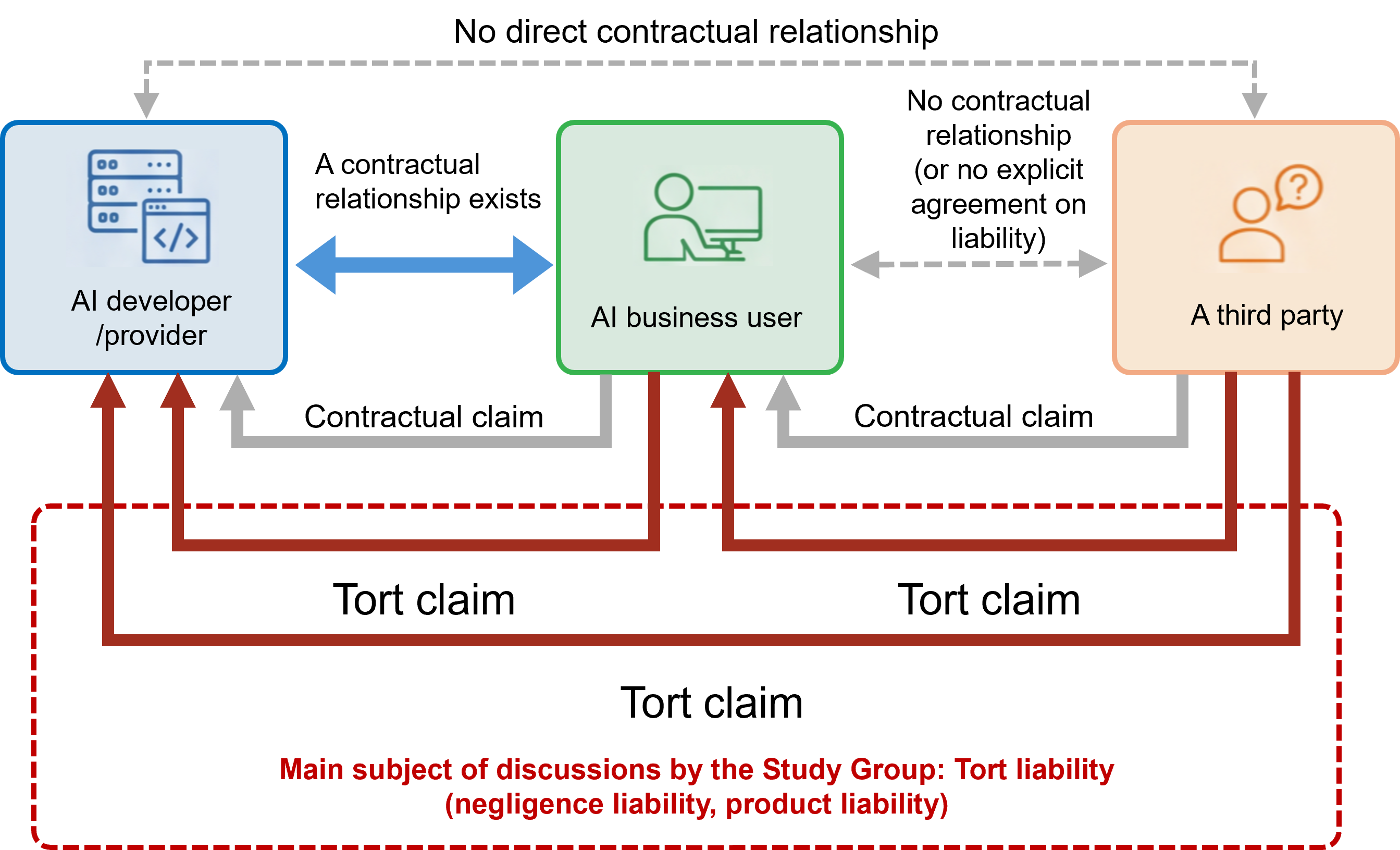
This guidance examines various hypothetical cases involving accidents caused by AI-based services and systems (AI for delivery route optimization ,AI for assisting legal services , Image generation AI, transaction screening AI, visual inspection AI, autonomous mobile robots [AMRs], and in the appendix, AI agents).
Furthermore, based on the examination of each hypothetical case, the guidance classifies AI into two categories based on the mode of its utilization (Assistive/Supportive AI and Dependable/Substitute AI) to serve as a reference when determining the liability of each party involved.
Related Material

Related Links(in Japanese)
Divisions in Charge
Digital Economy Division, Commerce and Information Policy Bureau
AI Industry Strategy Office, IT Industry Division, Commerce and Information Policy Bureau
 Download(To Adobe site)