

Keeping Resources in
Circulation to Enrich
Both the Economy
and the Environment
Outreach Classes
Learning About the
Circular Economy in a
Fun and Engaging Way
As part of its efforts to raise awareness of the circular economy, a way of thinking that values the Earth by avoiding waste and keeping products and materials in use, Japan’s Ministry of Economy, Trade and Industry organized a series of outreach classes. During the classes, children learned about the circular economy in an enjoyable and engaging way through the manga booklet Circular Economy Survival, created in collaboration with the hugely popular Survival Science Manga series for elementary- school students, as well as through an original card game.

The circular economy
enriches both the economy
and the environment
Keeping resources and the economy
in circulation
The term “circular economy” refers to a system that keeps resources in circulation in order to enrich both the economy and the environment.
Rather than throwing things away after using them just once, the circular economy is about repairing products and using them for as long as possible, or turning them into materials for new products. By doing so, both resources and economic value are kept circulating. This is what the circular economy is all about. But why is such a system necessary?
One reason is that there are fewer and fewer places left to bury waste (final disposal sites). If no action is taken, landfill sites across Japan are expected to reach capacity in an average of just 24.8 years.
Another reason is that plastics produced on land are harming marine life. Plastic bags and tiny plastic particles that flow into the ocean can be swallowed by sea creatures, while polluted seawater damages marine environments.
Waste also gives rise to many other social issues. That is why it is essential to treat waste as a resource and put it back into circulation.

Rethinking what we
take for granted
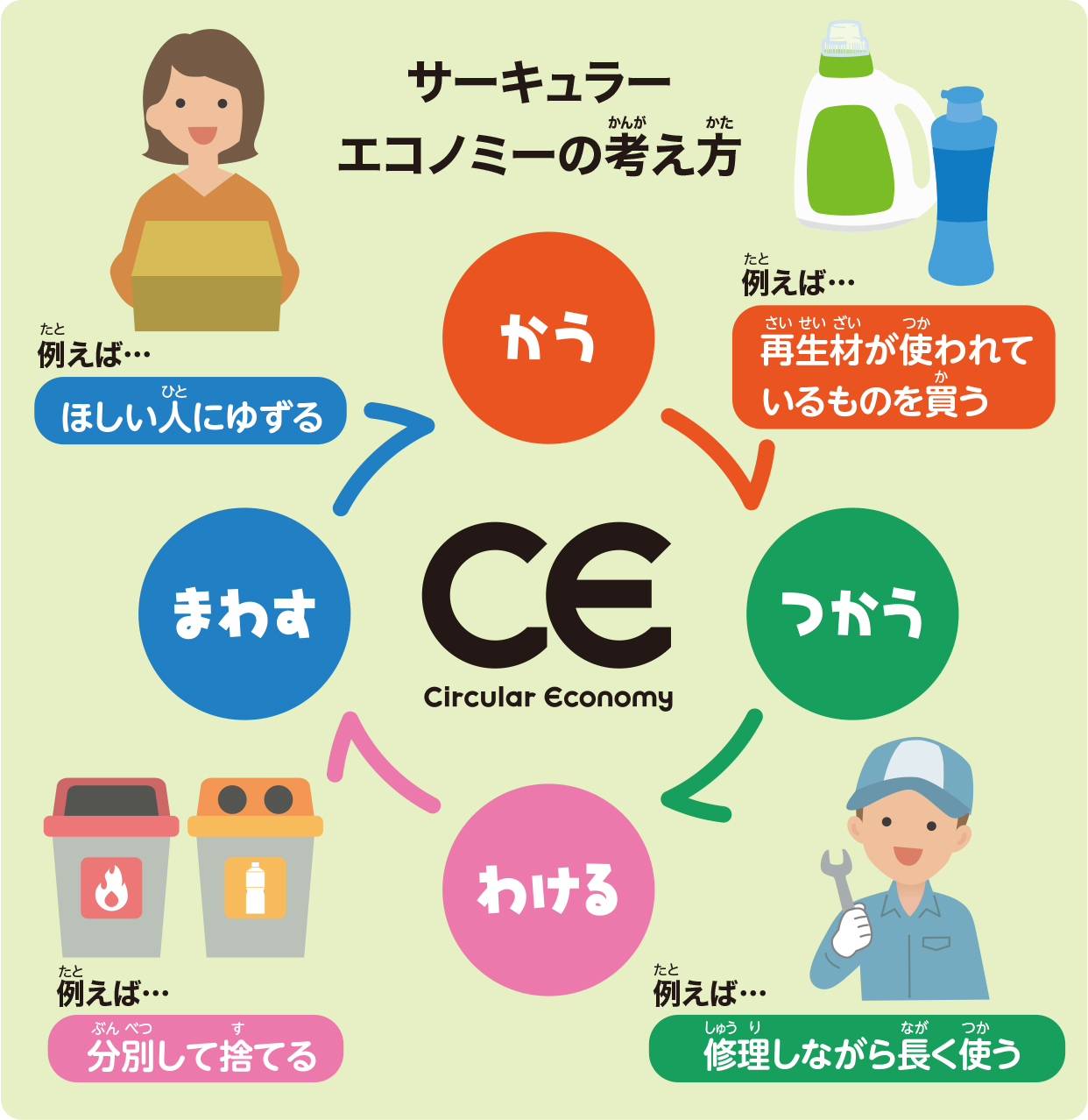
So what kinds of actions contribute to the circular economy? Let’s look at the flow of how “things” circulate through four stages: Buy, Use, Sort, and Pass On.
When we “Buy” items at a store, have you ever noticed products labeled “made with recycled materials”? Recycled materials are created by collecting waste, breaking it down into small pieces, and processing it so it can be used as raw material for new products. For example, there are initiatives that turn recycled fishing nets used at sea into school backpacks.
What about when we “Use” things? Examples include buying only the colors you have run out of when replacing colored pencils or paints, repairing broken items and continuing to use them for as long as possible (repair), or viewing materials on tablets instead of printing them on paper (paperless).
You might think, “That’s just common sense.” But it is important to take a moment to reflect on whether you are really putting these actions into practice in your everyday life.
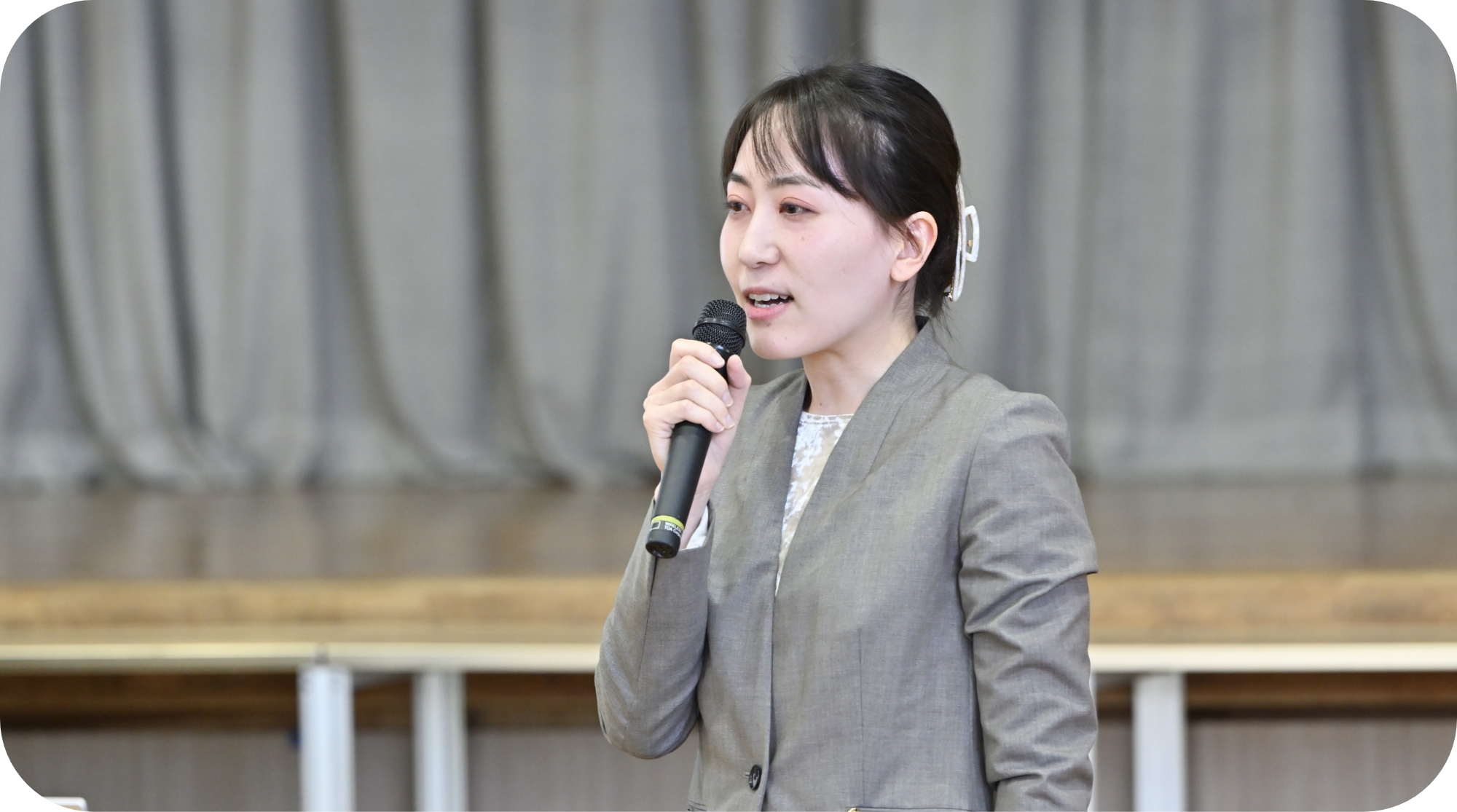
Instructor Eri Imai from the Ministry of Economy, Trade and Industry

Learning how to sort waste
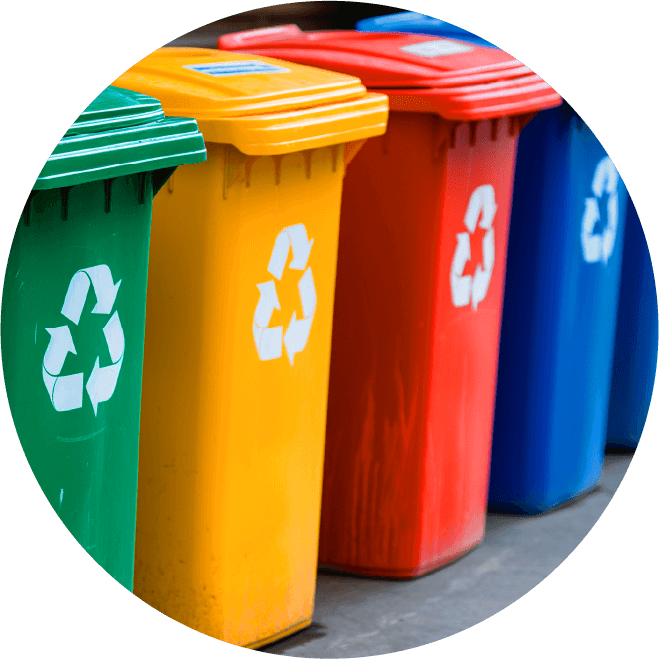
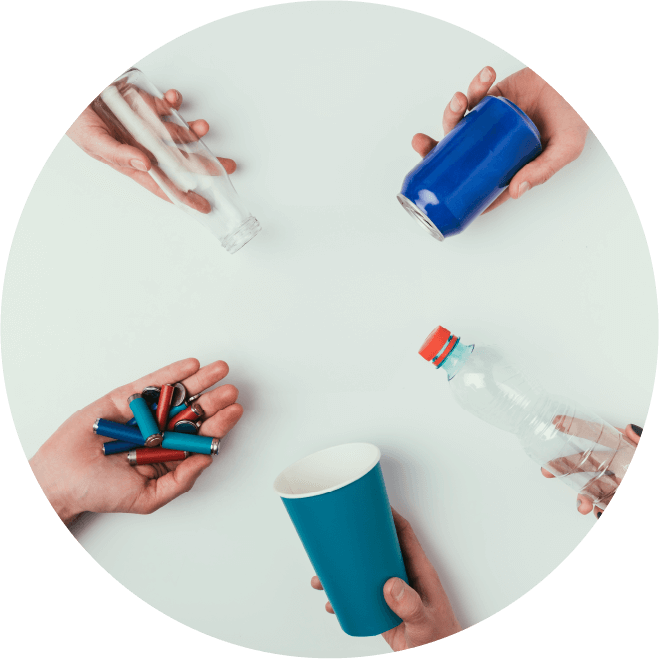
When we talk about “Sort”, we mean separating waste properly. Waste is divided into categories such as burnable waste, non-burnable waste, cans, bottles, and PET bottles, with the specific rules set by each municipality. Be sure to learn how waste should be sorted where you live.
As an example of “Pass On”, let’s look at flea markets. These are events where items you no longer need but are still usable are passed on at a low price to people who want them. Today, it is also possible to use flea market apps to buy and sell items easily using a smartphone.
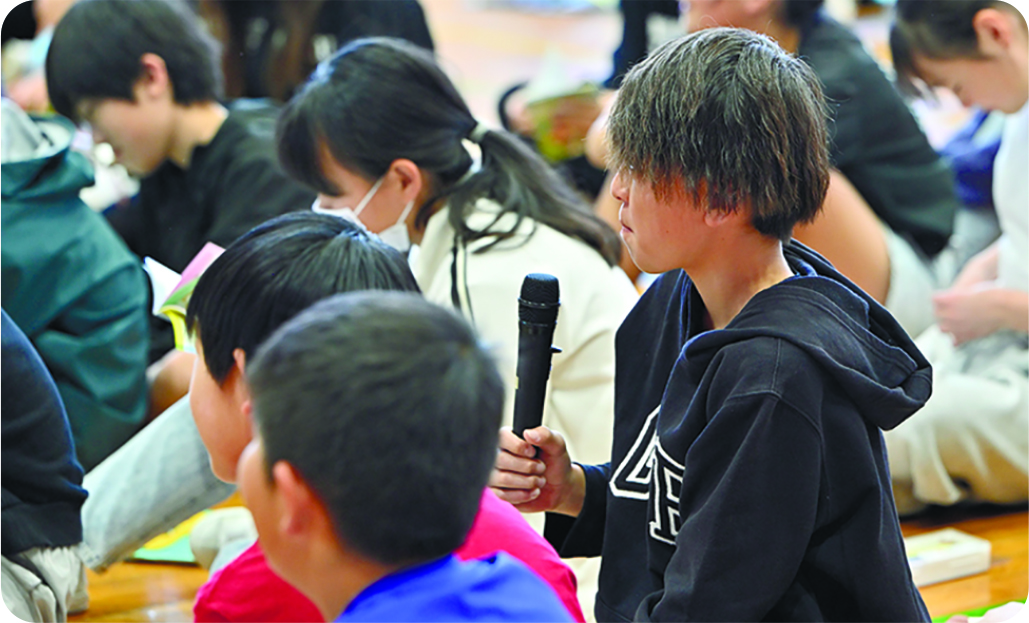
Students actively responded to the instructor’s questions, creating a lively and engaging class
Declare your commitment
to the circular economy
Thinking about what we can do
through a card game
To find even more examples of the circular economy, a card game was used. Each card clearly describes an action, such as “Sharing” (using things together) or “Composting” (turning food waste into compost), and the cards come in matching sets of two to four. When a complete set is found, the cards are collected, and the player who ends up with the most cards at the end wins the game.
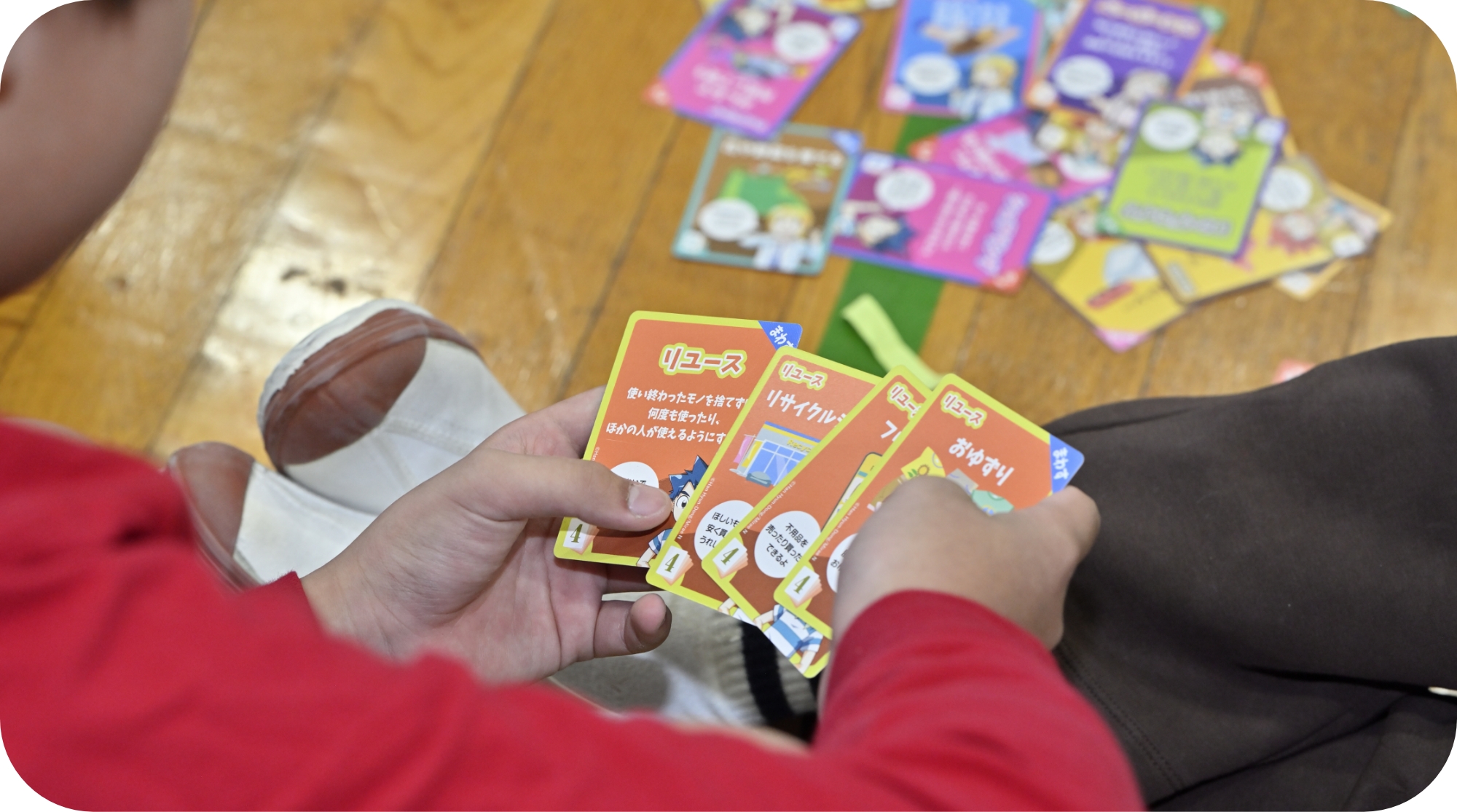
Like a memory card game, students flipped the cards to find matching sets. Some groups became highly competitive, while others worked together, creating a fun and lively atmosphere.

While playing the game, students thought about which actions they would choose and which cards were their favorites. After the game ended, each group declared the actions they wanted to take going forward.
The students shared a wide range of ideas, such as “I want to repair my soccer cleats and use them for a long time,” “I’d like to try composting,” and “I want to use refillable products.”
Through the class, the students learned about the circular economy and wrote down actions they could take on a worksheet. Those of you reading this article can also start making changes to your own actions in your everyday lives.
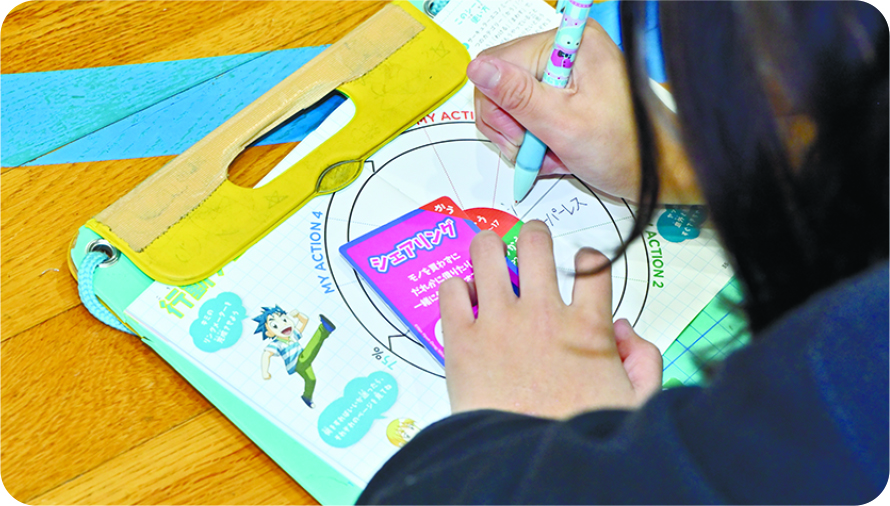
Using the card game as inspiration, students wrote down the actions they want to take for the circular economy.
The circular economy is about keeping resources and economic value in circulation so that both the economy and the environment can be enriched together.
To promote the circular economy, the key points are:
- ❶ Choose products made with recycled materials
- ❷ Repair items and use them with care
- ❸ Sort waste properly when disposing of it
- ❹ Pass on usable items to people who want them
These are the essential points!

Let’s take action now
to support
the circular economy!
Idagawa Elementary School,
Kameyama City, Mie Prefecture
128 sixth-grade students
participated
For the students of Idagawa Elementary School, this was their first encounter with the term “circular economy.” They listened attentively throughout the talk. In contrast, the card game session was full of excitement, helping them learn many concrete examples of the circular economy. In the end, the students connected what they had learned to their own lives and declared the actions they wanted to take going forward.
Comments
from participating students
- “I learned about the circular economy. Since I play baseball, I want to keep maintaining my equipment and continue using it for a long time.”
- “The issue of landfill sites really stayed with me. I want to work on the circular economy to help protect the Earth.”
Shinho Elementary School,
Higashikurume City, Tokyo
42 fourth-grade students
participated
The students of Shinho Elementary School followed along closely with the manga booklet, quickly finding the relevant pages and impressing the instructor, Ms. Imai. During the card game, homeroom teachers also joined in, making the activity even more engaging. After the game, the students spread out the cards and talked together, saying things like “We’re already reusing things” and “What does local production for local consumption mean?” as they thought about actions they would like to take next.
Comments
from participating students
- “I hope I can make use of what I learned today in my everyday life. I want to give my things to my younger brothers so they can reuse them.”
- “I learned about the four categories of the circular economy. The card game was educational and easy to understand.”
Organized by:
Asahi Elementary School Newspaper
Ministry of Economy, Trade and Industry
FY2024 supplementary budget project to promote collaboration among relevant stakeholders to accelerate a resource-autonomous economy